
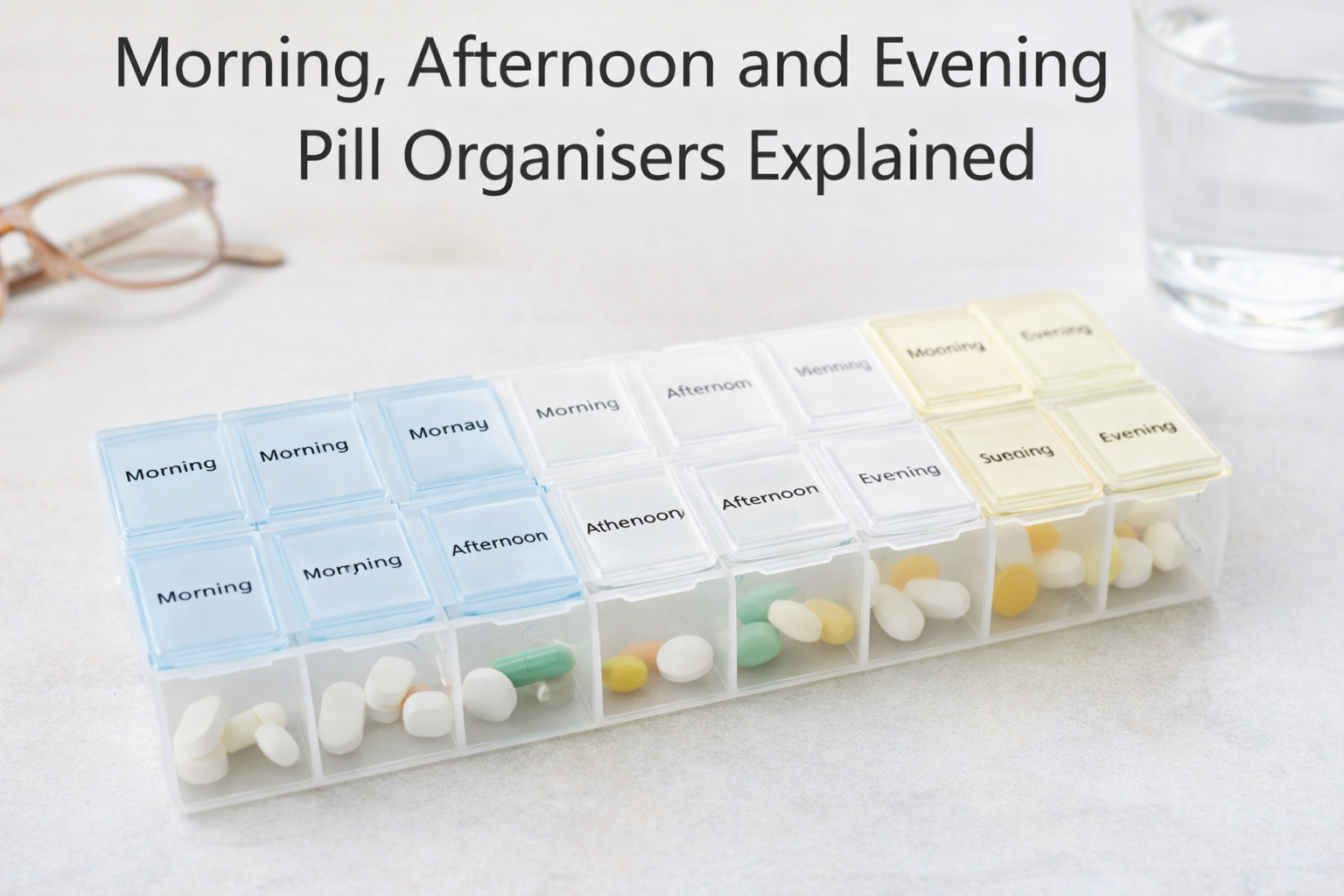
Managing medication at home can feel straightforward at first, but it often becomes more complicated once doses are needed at different times of the day. Morning, afternoon and evening pill organisers are designed to support this routine, helping people keep track of when medication is taken and reducing the chance of missed or duplicated doses.
This guide explains how these organisers work, who they are commonly used for, and what many carers consider when choosing one.
This article is for general information only and does not provide medical advice. Medication routines should always follow the guidance provided by a pharmacist or prescriber.
What is a morning, afternoon and evening pill organiser?
A morning, afternoon and evening pill organiser is a type of medication organiser that separates tablets or capsules by time of day, rather than just by date.
Some links on this page are affiliate links. If you buy through them we may earn a small commission at no extra cost to you.
Instead of one compartment per day, these organisers usually have:
- Three compartments per day (morning, afternoon, evening), or
- Separate removable sections for each time period
Many carers first come across these when looking at three-times-a-day pill organisers or daily pill boxes with time labels, which are widely available through pharmacies and online retailers such as Amazon.
Why time-of-day organisers are often chosen
Many people start with a simple daily or weekly pill box. Over time, this can become harder to manage if:
- Medication is taken at different times
- Some tablets are taken with food and others are not
- Multiple people are involved in care
- Memory problems are present
Time-of-day organisers can help by creating a clearer visual routine. Some carers find that pill organisers labelled morning, afternoon and evening make it easier to check whether a dose has already been taken, especially during busy or disrupted days.
Who commonly uses these organisers?
Morning, afternoon and evening pill organisers are often used by:
- People taking medication three times a day
- Family carers supporting someone else at home
- Older adults managing multiple prescriptions
- Households where more than one person handles medication
- People who find written medication schedules difficult to follow
For carers, having a clearly labelled daily pill organiser can reduce uncertainty when care is shared between family members.
You may want lockable storage boxes for safe storage of daily pill organisers. You can read what to look for in our guide Lockable Medication Boxes for Home Carers.
Different types of morning, afternoon and evening organisers
There is no single design. Several formats are commonly available.
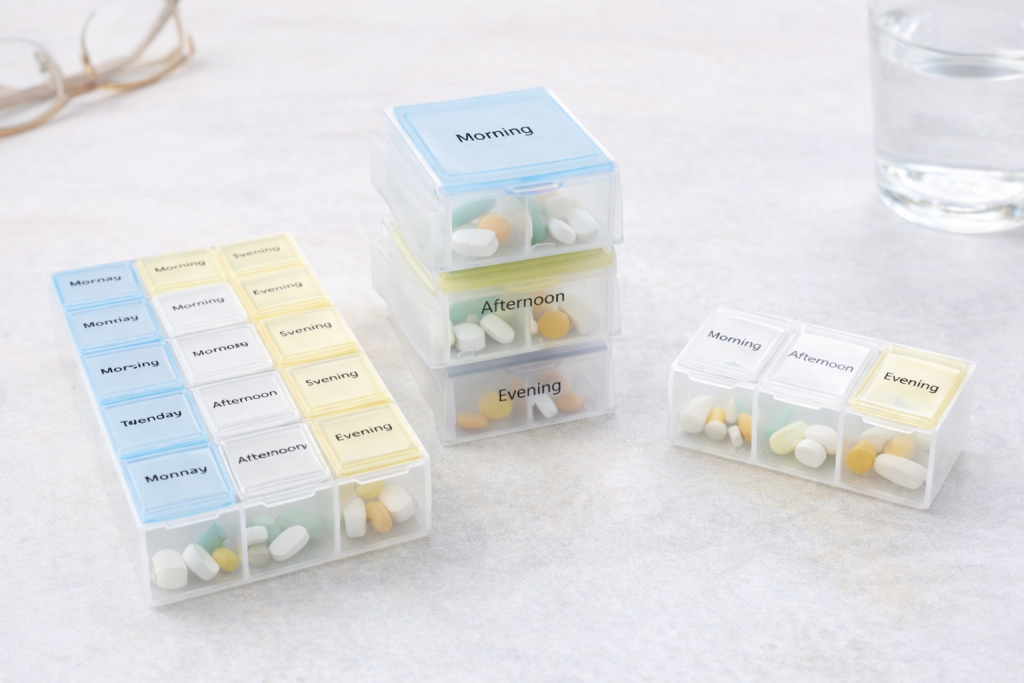
1. Fixed weekly organisers with three compartments per day
These are usually rectangular boxes covering seven days, with each day divided into morning, afternoon and evening sections.
They are often seen as weekly pill organisers with AM, midday and PM compartments, and are commonly chosen because:
- The full week can be prepared in advance
- Everything is visible at once
- No parts need to be removed or carried separately
Many carers browsing Amazon look for large weekly pill organisers with time-of-day sections, particularly where several tablets are taken at once.
2. Daily organisers with removable sections
Some organisers contain individual daily pods, each split into three time periods.
These are often described as daily pill organisers with removable compartments, and are commonly chosen because:
- One day can be carried when leaving the house
- A carer can prepare multiple days ahead
- Missed doses are easier to spot
This style can be helpful when medication needs to be taken outside the home or when routines vary day to day.
3. Stacked or sliding organisers
These organisers store morning, afternoon and evening compartments as separate layers or trays.
They are sometimes sold as stackable pill organisers or pill organisers with sliding trays, and are often chosen because:
- Compartments are larger
- Tablets are easier to access
- Visual separation is very clear
Some carers prefer these designs when tablets are bulky or when hand strength is reduced.
What many carers look for when choosing one
When comparing options, carers often focus on practical details rather than appearance.
Clear labelling
High-contrast labels such as “Morning”, “Afternoon” and “Evening” can make a significant difference, particularly where memory or vision is affected.
Easy-to-open lids
Some pill organisers available online are specifically designed with push-button or soft-opening lids, which can reduce frustration and spillage.
You may be interested in our guide Best Pill Organisers for Arthritis or Weak Grip to promote independence for people with arthritis or weak grip.
Adequate compartment size
When looking at product listings, carers often check photos carefully to ensure compartments can hold multiple tablets comfortably.
Stability
Organisers that sit flat and do not tip easily are often preferred, particularly on busy kitchen surfaces.
Visibility
Transparent lids allow carers to see at a glance whether a dose has been taken, which is one reason clear pill organisers are commonly chosen.
Morning, afternoon and evening organisers vs other options
It can help to understand where these organisers fit compared to alternatives.
Compared to once-daily pill boxes
Time-of-day organisers offer more structure when medication is taken multiple times daily. Simple daily pill boxes may still suit very consistent routines.
Compared to weekly organisers without time separation
Weekly organisers without time labels can become confusing once more than one dose per day is involved.
Compared to automatic pill dispensers
Automatic dispensers are available through specialist suppliers and Amazon, but many carers prefer manual organisers because they are:
- Easier to check
- Less technical
- Simpler to clean
- Quieter and more portable
Common situations where they are used
Carers often mention these organisers being helpful when:
- Supporting someone with memory problems
- Managing medication changes after a hospital discharge
- Coordinating care between different family members
- Reducing reliance on written reminder notes
- Establishing a new routine after diagnosis
In many households, a morning, afternoon and evening pill organiser becomes part of a wider medication system rather than a standalone solution.
Using a time-of-day organiser safely
Although organisers can support safer routines, they are not risk-free.
Some carers find it helpful to:
- Fill organisers in a calm, uninterrupted environment
- Double-check medication lists before filling
- Keep organisers out of reach of children or pets
- Store them away from heat and moisture
- Review routines regularly if prescriptions change
For specific medicines, a pharmacist can advise whether storing tablets in an organiser is appropriate.
Are morning, afternoon and evening pill organisers right for everyone?
Not always.
They may be less suitable where:
- Medication timings change frequently
- Tablets need to remain in original packaging
- Liquids or variable doses are involved
- A person cannot reliably open compartments
In these cases, alternative storage or reminder methods may be more appropriate.
Frequently asked questions
Are these organisers suitable for dementia care?
Some carers use them as part of a wider support routine. Suitability depends on the individual and the level of supervision involved.
Can medication be stored long-term in organisers?
This depends on the medication. Some tablets are sensitive to light or moisture. A pharmacist can advise on specific medicines.
Do these organisers replace medication charts?
They are often used alongside charts rather than instead of them, particularly where more than one carer is involved.
Final thoughts
Morning, afternoon and evening pill organisers are a practical tool for managing more complex medication routines at home. They do not replace professional advice or oversight, but many carers find they provide structure, visibility and reassurance when used thoughtfully.
Understanding the different designs available can help households make calmer, more informed decisions when choosing a pill organiser that fits their routine.