
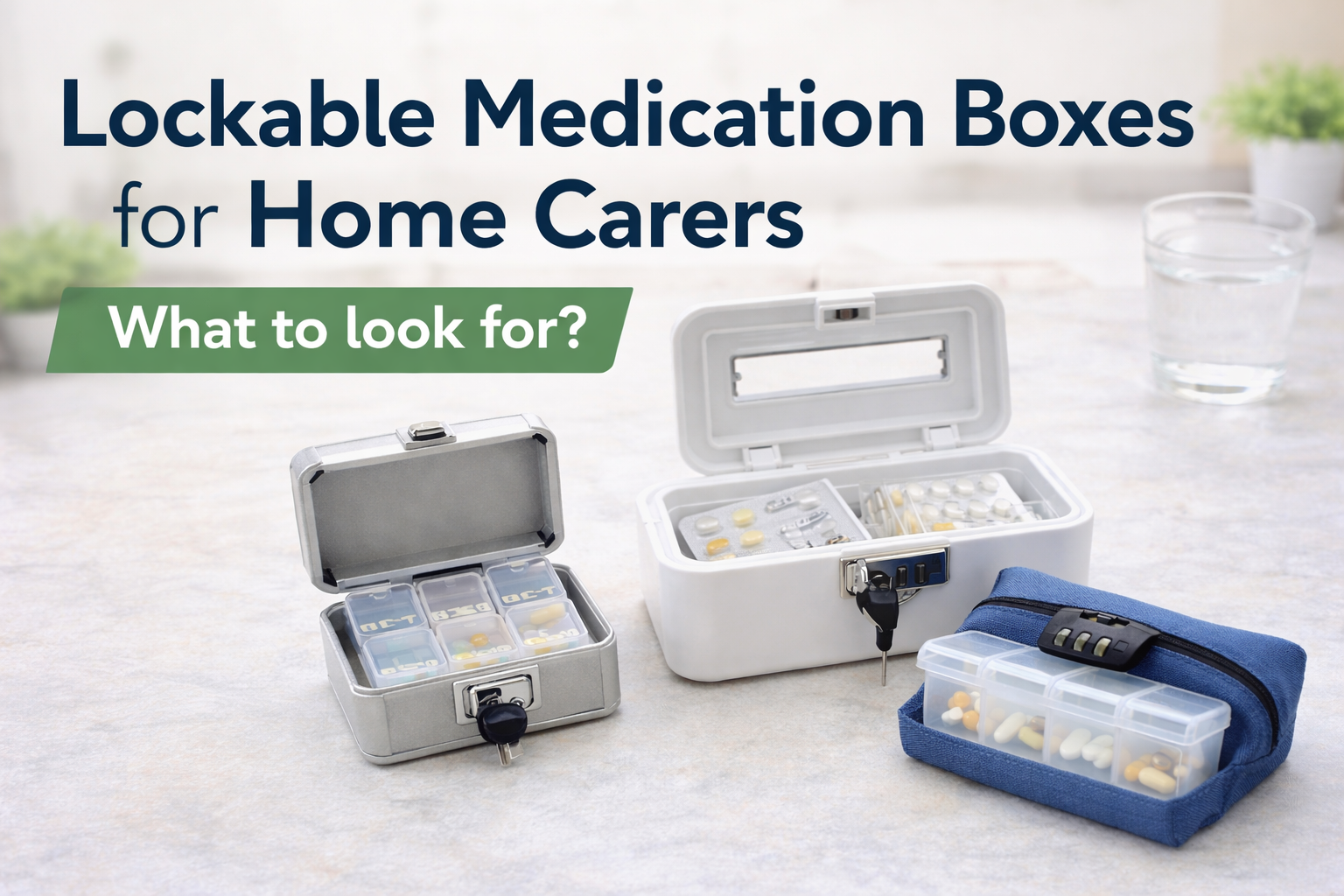
When medication is managed at home, safety is not only about taking the right dose at the right time. For many carers, it also involves making sure medication is stored securely, especially where there are memory problems, children in the home, or multiple people involved in care.
Lockable medication boxes are one option that some households use to reduce risk and create clearer boundaries around medication access. This guide explains what they are, when they are commonly used, and what carers often consider when choosing one.
This article is for general information only and does not provide medical advice. Medication storage should always follow guidance from a pharmacist or prescriber.
What is a lockable medication box?
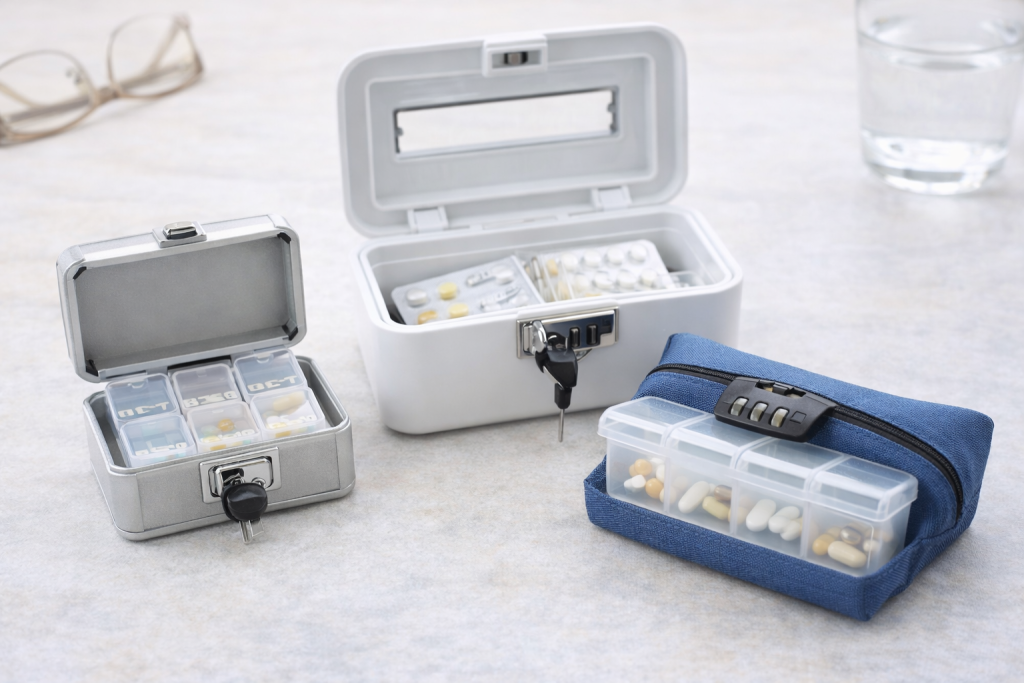
A lockable medication box is a container designed to store medicines securely, using a key lock, combination lock, or digital locking mechanism.
Some links on this page are affiliate links. If you buy through them we may earn a small commission at no extra cost to you.
They are typically used to:
- restrict unsupervised access to medication
- reduce the risk of accidental ingestion
- support shared or supervised care arrangements
- add an extra layer of reassurance for carers
When carers search online, they often come across these under terms such as lockable medication boxes, locked pill boxes, or medicine lock boxes for home use, which are widely available through pharmacies and retailers such as Amazon.
Why carers sometimes choose lockable storage
Not every household needs locked medication storage. Where it is used, it is usually in response to a specific risk or concern, rather than as a default.
Situations where carers often consider lockable boxes include:
- supporting someone with memory problems or confusion
- managing medication in households with children
- storing strong pain relief or sedative medicines
- sharing care responsibilities between family members
- concerns about missed, duplicated or inappropriate doses
For some carers, the presence of a lock provides clarity and reassurance, rather than relying on verbal reminders alone.
Lockable boxes and independence
One concern carers sometimes raise is whether locked storage reduces independence.
In practice, many households use lockable boxes in a balanced way, for example:
- medication is locked when not supervised
- carers unlock the box at agreed times
- medication is still organised into daily or time-of-day organisers once accessed
Some carers combine lockable storage with time-of-day pill organisers, which can help maintain routines while managing access. If you’re deciding between these approaches, you may find this guide helpful: Morning, Afternoon and Evening Pill Organisers Explained.
You may be interested in our guide Best Pill Organisers for Arthritis or Weak Grip to promote independence for people with arthritis or weak grip.
Different types of lockable medication boxes
There is no single “best” type. The most suitable option often depends on the home environment and the level of supervision involved.
1. Small lockable medication cases
These are compact boxes, often made of plastic or metal, secured with a key or combination lock.
They are commonly chosen because:
- they fit easily into cupboards or drawers
- they are discreet
- they are suitable for small quantities of medication
Many carers browsing Amazon look for small lockable pill boxes or portable medication lock boxes, particularly when space is limited or medication needs to be kept out of sight.
Some households store a filled pill organiser inside the locked box between doses.
2. Larger lockable medication boxes
Larger boxes can store multiple medicines, blister packs, or backup supplies.
They are often used where:
- several medications are prescribed
- more than one person’s medication is stored
- carers need space for original packaging and leaflets
These are often listed as large medication lock boxes or medicine storage boxes with locks, and are usually kept in a fixed location in the home.
3. Portable lockable boxes
Some lockable boxes are designed to be carried when travelling or attending appointments.
They are often chosen because:
- medication remains secure outside the home
- carers retain control during journeys
- routines can continue when away overnight
When searching online, carers often look for travel medication lock boxes or portable locked pill cases.
What carers often look for when choosing a lockable box
When comparing options, carers usually focus on practical and safety-related features rather than appearance.
Lock type
- Key locks are simple but require keys to be stored safely
- Combination locks avoid keys but rely on remembering the code
- Digital locks may offer convenience but require batteries
There is no universally better option. The most suitable choice is the one that works reliably in that household.
Ease of use
Locks should be:
- straightforward to open
- reliable
- not overly stiff or fiddly
A lock that is difficult for the carer to open can increase frustration and risk.
Size and layout
It can help to consider:
- whether original packaging needs to be stored
- whether pill organisers will be placed inside
- how many medicines are used regularly
Checking product photos and dimensions on Amazon listings can help avoid boxes that are impractically small.
Visibility and organisation
Some carers prefer boxes that allow:
- clear labelling inside
- separation of different medicines
- easy checking of contents
Others prefer opaque boxes that keep medication completely out of sight.
Lockable boxes compared with other storage options
Lockable medication boxes are one of several ways carers manage medication safety.
Compared with cupboards or drawers
Cupboards can be useful, but locks add a clear physical barrier rather than relying on memory or reminders alone.
Compared with safes
Household safes may be secure but are often:
- heavy
- inconvenient
- not designed for daily access
Medication-specific boxes are usually more practical for routine use.
Using lockable medication boxes safely
While locks can reduce risk, they do not remove the need for careful routines.
Carers often find it helpful to:
- keep the key or code in a consistent place
- avoid sharing codes widely
- review storage when medication changes
- ensure emergency access is possible if needed
- check that locks are functioning properly
A pharmacist can advise if there are specific storage requirements for individual medicines.
Are lockable medication boxes always necessary?
No.
Some households manage medication safely with:
- clear routines
- time-of-day organisers
- supervision at key times
- limited quantities stored at home
Lockable boxes are one option among many, and suitability depends on the situation.
Frequently asked questions
Are lockable medication boxes required for home care?
In most private home settings, lockable storage is a choice based on the situation rather than a blanket requirement. Some households use a lock to reduce risk where there are specific concerns, such as children in the home or memory problems.
What type of lock is easiest to manage day to day?
Many carers find a simple key lock or a straightforward combination lock easiest. Key locks can be simple but rely on keeping the key in a consistent, safe place. Combination locks remove the need for keys but can be frustrating if the code is forgotten.
Can medicines stay in their original packaging inside a lockable box?
Often, yes. Some people prefer keeping medicines in the original packaging so instructions, batch details and expiry dates remain clear. If you are unsure about a particular medicine, a pharmacist can advise on any specific storage requirements.
Is a lockable box better than a locked cupboard?
A locked cupboard can work well in some homes. A lockable box adds a portable layer of control and can be easier to keep consistent if different rooms are used or if medication needs to be moved for visits and appointments.
Do lockable medication boxes prevent medication errors?
A lock can reduce certain risks, such as unsupervised access, but it does not prevent errors on its own. Clear routines, careful filling, and reviewing changes to prescriptions still matter.
Are lockable boxes suitable where someone has dementia?
Some carers use lockable storage as part of a wider routine, particularly where there is a risk of repeated dosing or taking the wrong medicine. The most suitable approach depends on the individual and the level of supervision available.
Is it better to store a pill organiser inside the lockable box?
Some households do this, especially if medication is organised by time of day. It can help to reduce access between doses while still keeping the routine simple when the box is opened.
What size lockable medication box is usually most practical?
It depends on how many medicines are used and whether you want to store original boxes and blister packs. A slightly larger box often makes routines easier, as overcrowding can increase the chance of mix-ups.
Can lockable boxes be used for travel or appointments?
Yes, some are designed to be portable. Many carers look for compact lockable cases when medication needs to be carried outside the home, though it can help to consider weight and ease of opening when out and about.
Where is the safest place to keep a lockable medication box at home?
Many people choose a cool, dry place away from heat, moisture and direct sunlight, and out of reach of children. If you are storing medicines with specific temperature or storage needs, a pharmacist can advise on the best approach.
This FAQ section is general information only and is not medical advice. For medicine-specific guidance, a pharmacist is usually the best first point of contact.
Final thoughts
Lockable medication boxes can provide reassurance and structure in some home care situations, particularly where safety concerns exist. They are not a one-size-fits-all solution, but for many carers they form part of a wider approach to managing medication safely at home.
Understanding the different types available, and how they fit alongside other tools such as pill organisers, can help households make calm and considered decisions.